

For many people, the ideal retirement involves staying independent and making their own decisions for as long as possible. That helps explain why 75% of Americans age 50 and older say they would like to remain in their current homes as they age.
But wanting to remain independent and wanting to remain in the same house are not necessarily the same thing.
In fact, the same American Association of Retired Persons (AARP) survey found that 44% of adults 50 and older believe they may eventually need to move. For some, aging in place at home can work very well. For others, moving to a Life Plan Community while they are active and independent can provide a different way to age in place, with fewer home responsibilities and access to additional support if needs change.
The right choice depends not only on where you are comfortable today, but on how well your living situation can continue to support the life you want in the years ahead.
What Does Aging in Place Really Mean?
Aging in place is often interpreted as staying in the house where you currently live for the rest of your life. The concept is actually broader.
The U.S. Department of Housing and Urban Development describes aging in place as being able to live safely, independently, and comfortably in your own home and community, regardless of age, income, or ability level.
For many older adults, that can mean adapting a longtime home and arranging services as they are needed. But the underlying goal is not simply preserving an address. It is maintaining independence, comfort, connections, and access to appropriate support.
That distinction matters when comparing staying at home with moving to a Life Plan Community. Both can support independence, but they approach the future in different ways.
What Aging in Place at Home May Require
Remaining in a familiar home has meaningful advantages. You already know the neighborhood, have established routines, and may be surrounded by years of memories. If your home is appropriate for your needs and you have a strong support network, staying there may be exactly what you want.
However, successful aging in place usually requires looking beyond how well the house works for you today.
An Adaptable Home
Think about how your home would function if mobility changed. Are the bedroom and bathroom accessible without stairs? Is it easy to enter the house? Could the bathroom accommodate grab bars or other accessibility features? Is there adequate lighting?
These are not necessarily immediate concerns. They are questions about whether the property can adapt with you.
AARP found that 44% of adults 50 and older who expect to remain in their homes anticipate needing accessibility modifications. Common changes may include bathroom improvements, ramps, stair assistance, wider doorways, better lighting, or relocating essential living spaces to one floor.
A Support System That Can Change With You
The house itself is only one part of aging in place.
You may also need to consider transportation if driving becomes difficult, routine home maintenance, yard work, meal preparation, errands, and help with everyday activities. Family members may be able to provide some assistance, while other services may need to be hired and coordinated.
Aging in place at home can be a successful long-term choice. The important question is whether the home, finances, community, and support system can continue to adapt if circumstances change.
What Is Aging in Place Like in a Life Plan Community?
A Life Plan Community, also known as a Continuing Care Retirement Community (CCRC), takes a different approach.
Residents typically move into independent living while they are active and able to enjoy the community’s lifestyle, amenities, and social opportunities. If their health or support needs change later, additional levels of care are available.
At Riddle Village, that continuum includes independent living, personal care, skilled nursing, rehabilitation, and respite care. You can learn more about how these options work together in our guide to CCRCs, Life Plan Communities, and Lifecare.
The important difference is timing. Moving into a Life Plan Community allows you to establish a new home and social network. At the same time, you are independent instead of waiting for a health event or other urgent situation to force a decision.
Aging in Place vs. a Life Plan Community: A Side-by-Side Comparison
Neither option is universally better. What matters is how each one fits your priorities and long-term plan.
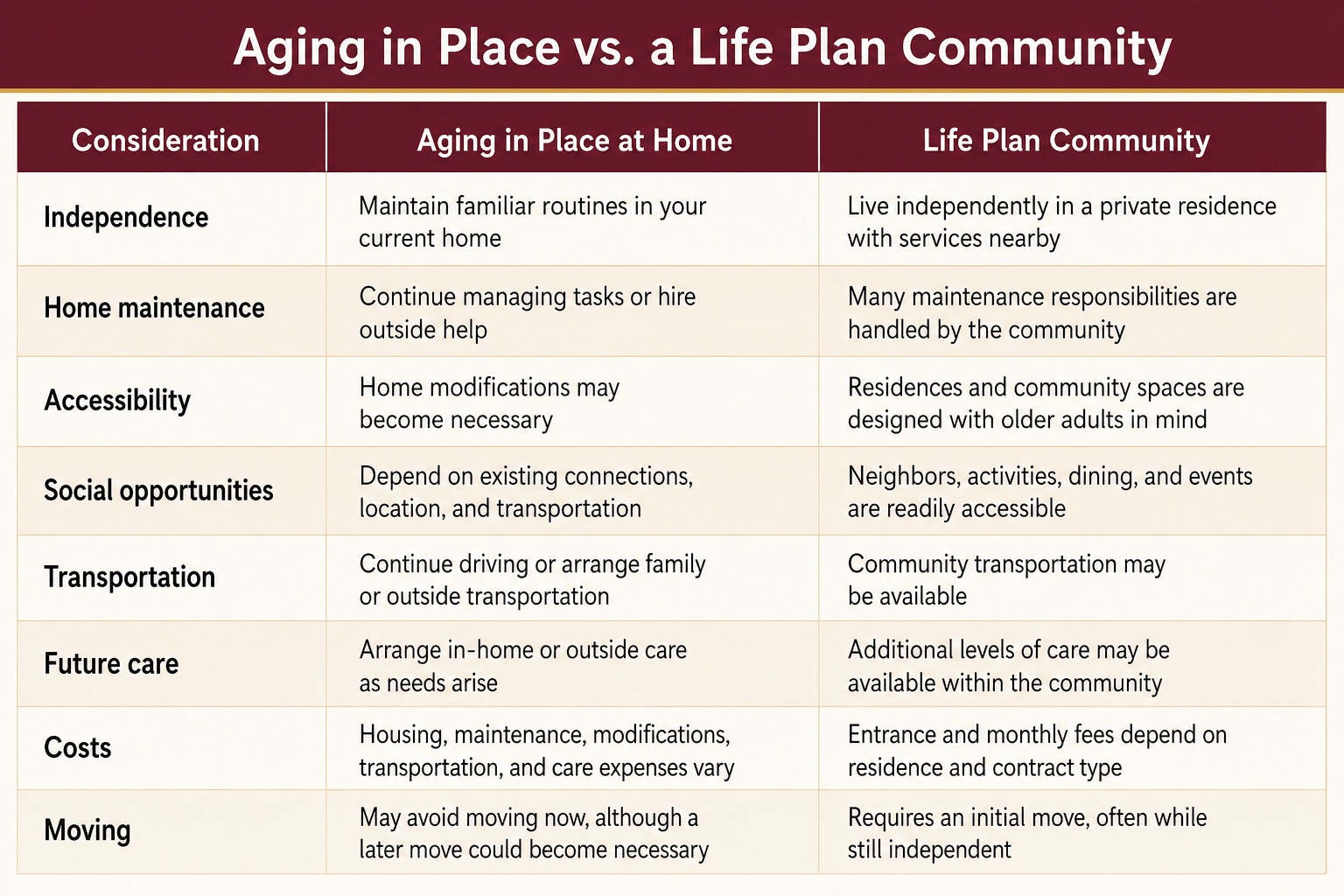
The comparison becomes especially useful when you think several years ahead rather than focusing entirely on your current circumstances.
Look Beyond Your Needs Today
One of the most helpful ways to evaluate aging in place is to imagine what an ordinary week could look like five, 10, or 15 years from now.
Consider questions such as:
- Would the house still work well if stairs became difficult?
- How would you get to appointments, shopping, or social activities if you stopped driving?
- Who would take care of landscaping, repairs, and seasonal maintenance?
- Would it be easy to maintain friendships and regular social activities?
- Where would additional help come from if you needed assistance with daily activities?
- What would happen if you or your spouse needed skilled nursing care?
- Does your plan depend heavily on an adult child, spouse, friend, or neighbor?
These questions do not mean that it is time to move. Instead, they can uncover areas worth planning for while you still have plenty of choices.
If these questions raise concerns about your current plan, our article on signs it may be time to plan for future care can help you examine your situation more closely.
Don’t Compare the House You Have Today With the Care You Might Need Tomorrow
Cost can complicate the decision, as staying in a mortgage-free home may initially seem far less expensive than moving to a retirement community.
But those two numbers do not always represent equivalent lifestyles.
A more useful comparison considers your complete living situation. At home, that may include property taxes, insurance, utilities, repairs, landscaping, transportation, home modifications, entertainment, and potentially in-home assistance or future care.
A Life Plan Community may consolidate many services and conveniences into its fees while also providing amenities, activities, transportation, maintenance, and access to future care, depending on the community and contract.
The goal is not to prove that one arrangement costs less. It is to compare what you receive, what you remain responsible for, and how predictable your future expenses may be.
For a more detailed financial discussion, read How Much Does a Life Plan Community Cost in Pennsylvania?.
Can You Still “Age in Place” After Moving?
Yes. Aging in place does not have to mean remaining in the same house forever.
It can also mean deliberately choosing a new home better suited to the life you expect to lead in retirement, and then remaining in that community as your needs evolve.
At Riddle Village, Independent Living gives residents the freedom of their own apartment while reducing many of the responsibilities associated with maintaining a house. Residents also have convenient opportunities for dining, fitness, activities, transportation, and social connection.
Riddle Village’s Lifecare model adds another layer of planning. Residents have access to a continuum of care within the community if their needs change, helping them remain in familiar surroundings and close to established friendships and routines.
In that sense, moving can sometimes be part of an aging-in-place strategy rather than the opposite.
Which Option Is Right for You?
Aging in place at home may make sense if your home can be adapted, you enjoy maintaining it, you have reliable transportation and social connections, and you have a realistic plan for obtaining additional support if it becomes necessary.
A Life Plan Community may be worth exploring if you want fewer household responsibilities, easier access to activities and social opportunities, or the reassurance of having future care available as part of a long-term plan.
Most importantly, you do not need to wait until you need help to make the decision.
Planning while you are independent gives you time to compare options, understand costs, visit communities, involve family members when appropriate, and decide what kind of retirement lifestyle you actually want.
Explore What Aging in Place Could Look Like at Riddle Village
Aging in place is ultimately about creating a living situation that continues to support your independence, comfort, connections, and quality of life.
For some people, that means adapting a longtime home and bringing in services when needed. For others, it means choosing a community where an independent lifestyle and access to future care are already part of the plan.
If you are considering your options, schedule a visit to Riddle Village in Media, Pennsylvania. Seeing the community firsthand can help you decide which approach to aging in place feels right for the future you envision.
Sources
- AARP. (2024). Home and community preferences and future possibilities.https://www.aarp.org/pri/topics/livable-communities/housing/2024-home-community-preferences/
- AARP. (2024, December 10). Older adults want to age in place, but many don’t expect to.https://www.aarp.org/home-living/home-community-preferences-survey-2024/
- U.S. Department of Housing and Urban Development. (n.d.). Aging research and resources.https://www.huduser.gov/portal/Aging_RR.html